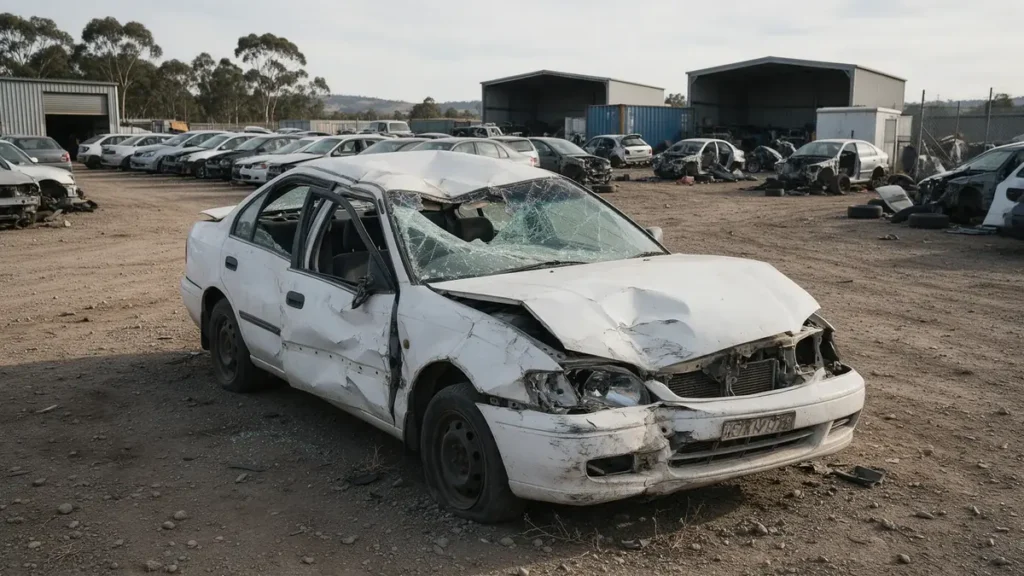
You can sell a written-off car in Melbourne, but what you can do with it depends on its write-off type. A statutory write-off can never be registered again, so it sells for parts, dismantling or scrap. A repairable write-off can be sold as it is, or repaired and put back on the road after inspection.
The fastest route for most owners is to confirm the write-off type, sell the car to a licensed wrecker or parts recycler, and lodge the transfer paperwork straight away. Private buyers and repairers only make sense for repairable write-offs with real value left in them. This guide explains each write-off type, what your insurer’s decision means for you, and the steps to sell without loose ends.
What do statutory, repairable and inspected write-offs mean in Victoria?
Victoria records written-off vehicles on the Written-Off Vehicles Register (WOVR), which is run by the Department of Transport and Planning. According to Transport Victoria’s written-off vehicles guidance, the register covers written-off vehicles under 15 years old: light vehicles up to 4.5 tonnes gross vehicle mass, and motorcycles. A car is written off when repairs would cost more than it is worth, or when the damage makes it unsafe to drive.
Victorian law sets a precise test. A vehicle is a total loss when its fair salvage value plus the cost of repairs would be more than its fair market value just before the damage. That is why two cars with the same repair quote can get different outcomes.
The register uses three categories:
| Write-off type | What it means | Can it be registered again? | Typical buyers |
|---|---|---|---|
| Statutory write-off (SWO) | Damaged so badly it should not be repaired | No, anywhere in Australia | Wreckers and parts recyclers |
| Repairable write-off (RWO) | Repairable, but repairs likely cost more than the car is worth | Yes, after repairs to manufacturer standards, a VIV certificate and a roadworthy certificate | Wreckers, repairers, some private buyers |
| Inspected write-off (IWO) | A former repairable write-off that has been repaired and re-registered | Already registered | Any buyer, with disclosure |
A light vehicle becomes a statutory write-off when it meets set damage criteria. These include excessive structural damage (three indicators from the national damage assessment criteria), excessive fire damage, water inside the cabin up to or above the inner door sill, or stripping of parts to the point of write-off. Fresh, salt or brackish water all count.
Hail damage sits in a grey area. Transport Victoria notes that a hail-damaged car may be recorded as an inspected write-off even if the damage has not been repaired. If hail or flooding caused your write-off, our guide to selling a hail or flood damaged car in Melbourne covers that situation in more detail.
How do you check your car’s write-off status?
Do not guess the category. It decides who can legally use the car and what it is worth. You have three ways to confirm it:
- Read your insurer’s paperwork. The total loss letter or claim settlement should state whether the car was recorded as a statutory or repairable write-off.
- Run a PPSR search. A $2 online search on the Personal Property Securities Register shows whether the car is recorded as written off or stolen, and whether money is still owed on it.
- Check with VicRoads. If the car was in your name when it went on the WOVR, you should receive a letter explaining its status and next steps.
The PPSR search does double duty. If a finance company still holds a security interest over the car, you need to settle that debt or get the lender’s agreement before any buyer can take clear title.
What happens to your registration once the car is on the WOVR?
This catches many owners off guard. When a vehicle is added to the WOVR as a repairable write-off, its registration is cancelled. The car is no longer road legal, even if it still starts and drives. You cannot drive it to a buyer, a repairer or an inspection, so plan for it to be towed.
A statutory write-off has an extra rule. It must carry a label warning potential buyers of its WOVR status. Transport Victoria specifies a white label with black lettering at least 9 mm high, and recommends a size of at least 230 x 170 mm. If you are selling a statutory write-off, check that this label is fitted.
The write-off record stays with the vehicle identification number (VIN) for good. Repairing the car does not remove it, and any future buyer who runs a PPSR search will see it. Being upfront about the write-off from the first conversation avoids disputes later.
What are your options after an insurer writes off your car?
Most owners only start thinking about selling after the insurer has made its call. Before you accept, you have more choices than it may seem.
Accept the settlement and let the insurer keep the wreck. This is the most common outcome. Under most policies the insurer pays out the agreed or market value, takes ownership of the salvage and sells it. You have nothing left to sell.
Ask to keep the wreck. The Australian Financial Complaints Authority (AFCA) explains that most policies let the insurer keep the salvage, but not all. Where you are allowed to keep it, the insurer usually deducts the salvage value from your payout. Keeping it only pays off if you can sell the car or its parts for more than that deduction.
Dispute the decision. If you believe the car was worth more, or was economical to repair, you can complain to the insurer and then to AFCA. AFCA has overturned write-off decisions where the insurer undervalued the car. It cannot remove a WOVR listing that was made correctly, though.
Uninsured or third-party-only cars. If you had no comprehensive cover, there is no insurer decision. The car is yours to sell. A wrecker that dismantles a car not already on the register must record it on the WOVR within seven days of starting work, so the paperwork side is handled at their end.
If finance is owing, the insurer usually pays the lender first. Check this before you agree to keep the salvage, because the lender may need to approve it.
Who will buy a written-off car in Melbourne?
Your realistic buyers depend on the category.
Licensed wreckers and parts recyclers
This route works for every type of write-off. A wrecker values the car for its reusable parts and its metal weight, not as a running vehicle. Damage to one end of a car often leaves the engine, gearbox, doors, lights or interior in good order, and those parts carry real value. Wreckers also handle towing, which matters when the registration has been cancelled.
For a statutory write-off, this is usually the only practical option, because no one can register the car again.
Repairers and rebuilders
A repairable write-off can suit a repairer who plans to fix it, obtain a Vehicle Identity Validation (VIV) certificate and a roadworthy certificate, and register it again. Expect a lower offer than you might hope. The buyer carries the repair cost, the inspection cost and the risk of hidden damage.
Private buyers
Private sales of repairable write-offs are possible but slow. The car cannot be test driven on public roads, and many buyers walk away once a PPSR search shows the write-off. If you go this way, disclose the category in writing and keep a copy.
What is a written-off car worth?
There is no fixed price. Offers depend on factors you can mostly check yourself:
- Make and model. Common models have steady demand for used parts.
- Age and kilometres. Newer cars usually have more parts worth recovering.
- Damage type. Front-end damage leaves different parts intact than a rollover. Fire and flood damage usually wipe out more value than a single impact.
- Engine and gearbox condition. A sound drivetrain lifts most offers.
- Weight and scrap metal prices. These set the floor value, and scrap prices move with the market.
- Completeness. Missing wheels, catalytic converters or batteries lower the price.
Give accurate details when you ask for a quote: make, model, year, damage type, write-off category and where the car is parked. Clear photos of each side and the engine bay help. A quote built on wrong details is the main reason offers change on pickup day. For a broader look at how these factors play out, see our guide to how much wreckers pay for cars in Melbourne.
How to sell a written-off car in Melbourne, step by step
- Confirm the category. Use your insurer letter or a PPSR search to confirm statutory, repairable or inspected.
- Check for finance. Clear any security interest, or get the lender’s written consent to the sale.
- Gather your documents. You need photo ID, proof you own the car and any insurer paperwork. Our checklist of documents to sell a car to a wrecker in Victoria lists them in full.
- Get quotes with accurate details. Ask each buyer whether towing is included and how they will pay.
- Expect payment by bank transfer. Since 30 May 2018, Victorian scrap metal dealers and auto wreckers have been banned from paying cash. Consumer Affairs Victoria’s scrap metal rules allow only electronic funds transfer or a non-transferable cheque, and the buyer must record your identity details. A buyer offering notes in hand is breaking the law.
- Remove personal items. Check the glovebox, boot and under the seats. Remove toll tags and unpair your phone.
- Hand over and lodge the paperwork. If the car is still registered, VicRoads requires a notice of disposal within 14 days of the sale. If you skip it, you may be liable for fines and tolls linked to the car. Keep a copy of the transfer form with both parties’ details.
Frequently asked questions
Can I sell a statutory write-off to a private buyer?
The law does not stop you, but the car can never be registered again anywhere in Australia. A private buyer can only use it for parts, so most statutory write-offs go to wreckers or parts recyclers. The car must also carry a label showing its statutory write-off status.
Do I need a roadworthy certificate to sell a written-off car?
No, not when you sell it as damaged. A roadworthy certificate is only needed when a repaired repairable write-off is being registered again, along with a VIV certificate.
Can I sell a written-off car with finance owing?
Only with the lender’s involvement. A PPSR search shows any registered security interest. The debt must be paid out, or the lender must agree, before the buyer can take clear ownership.
Will a wrecker pay me in cash?
No. Victorian wreckers and scrap metal dealers cannot pay cash for scrap vehicles. Payment is by electronic funds transfer or a non-transferable cheque, and you will need to show photo ID.
Moving a written-off car on, the right way
A write-off ends the car’s life on the road, not its value. Knowing the category tells you who can buy it. A PPSR search clears up finance questions, and paying by transfer and lodging the notice of disposal close off your liability. If your car is sitting in a driveway or a holding yard after an insurer’s decision, see how our car wreck removal service handles damaged and written-off vehicles, or request a quote for your written-off car with its make, model and write-off type.
Let’s Get It Sorted
Ready to Talk Through Your Project?
Share the details with our team and take the next step.
Call today:
0493 825 076