
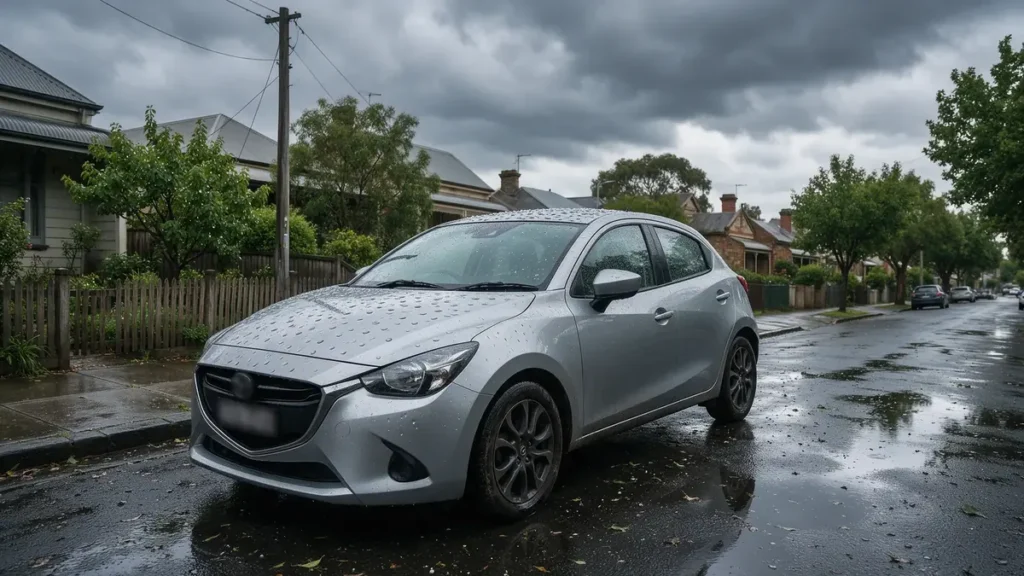
You can sell a hail damaged car in Melbourne privately, through your insurer’s claim process, or directly to a wrecker. Which route makes sense depends on two things: whether the damage is cosmetic or structural, and whether water got inside the cabin. Dents alone rarely stop a car from being sold or driven. Floodwater inside the car is a different matter, because it can turn the vehicle into a parts-only write-off.
Start with your insurance position, then check the car’s official write-off status, then pick the sale route that matches the damage. Getting that order right protects the payout you are entitled to and keeps the sale legal. The rest of this guide walks through each step for Melbourne owners, with the specific rules that apply to hail and flood damage in Victoria.
Is a Hail Damaged Car a Write-Off in Victoria?
A hail damaged car is not automatically a write-off, even after a big storm. When a hailstorm hit Casterton in Victoria’s south-west in October 2024, the local shire estimated it damaged around 600 cars, and each one still had to be assessed on its own damage. In Victoria, “written off” means an insurer has decided the repair cost is higher than the car’s value, or that the car is too damaged to be safe. That is an economic and safety call made by the insurer, not a label that comes with every dented roof.
Victoria also treats cosmetic hail damage differently from other damage. Since 30 September 2021, a car with only cosmetic damage from the direct impact of hailstones is no longer recorded on the Victorian Written-Off Vehicles Register (WOVR), according to Transport Victoria’s guidance on vehicles damaged by hail storms. You do not need to repair the dents, and you do not need a Vehicle Identity Validation (VIV) certificate, as long as the damage stays cosmetic.
That exemption has limits worth knowing before you sell:
- Hail plus other damage: if the car also has water or accident damage, it is added to the WOVR and the normal written-off rules apply.
- Interstate write-offs: a car recorded as a repairable write-off on another state’s register, even for hail only, still needs the hail repaired, a VIV certificate and a roadworthy before it can be registered in Victoria.
- Smashed glass and broken lights: these are safety defects, so the car may be legal to sell but not legal to drive until they are fixed.
For a deeper look at the write-off categories themselves, see our guide to selling a written-off car in Melbourne.
Why Flood Damage Is Treated More Harshly Than Hail
Flood damage is the line between a car that can go back on the road and one that never will. Under Schedule 6 of Victoria’s Road Safety Act 1986, a written-off light vehicle has “excessive water damage” if the internal cabin has been inundated with fresh, brackish or salt water above the level of the inner door sill. Excessive water damage makes a written-off vehicle a statutory write-off.
A statutory write-off recorded after 1 May 2002 can never be registered again. It can only be used for parts or recycling. That rule does not depend on whether the water was fresh or salt, or how long the car sat in it. The test is simply how high the water reached inside the cabin.
Three practical points follow for Melbourne owners after a storm or flash flood:
- Check the waterline before you talk to anyone. Look for silt, a tide mark on the door trims, or damp carpet and underlay. Photograph it.
- Do not try to start a car that has been sitting in water. Water drawn into the engine can bend internal parts and turn a claim into a dispute.
- Treat hybrid and electric cars with extra care. Floodwater can damage high-voltage batteries, and the risk may not show until later. Leave these cars switched off and tell your insurer or buyer they were submerged.
Older cars sit outside part of this system. Victoria’s WOVR covers light vehicles under 15 years old, so a flooded car older than that may not be recorded as a write-off at all. It still has to be disclosed honestly to any buyer, and the water damage still affects what it is worth.
Step One: Sort Out the Insurance Claim First
If the car is comprehensively insured, lodge the claim before you sell anything. Selling first can void your claim, because the insurer needs to inspect the car to assess it.
How much you receive on a total loss depends on your policy type. Moneysmart explains the two valuation methods used in comprehensive car insurance:
- Agreed value: a fixed amount set by you and your insurer, which often drops at each renewal.
- Market value: what the car would have sold for just before the damage, worked out by the insurer at claim time.
Expect deductions from either figure. These usually include your excess, any unpaid premium instalments, and the loan balance if the car is under finance. The lender is paid first and any remainder goes to you.
When an insurer settles a total loss, it normally keeps the damaged car. Some policies let you keep the car instead and accept a lower payout, a choice known as retaining the salvage. That can suit a car with cosmetic hail dents that still drives well. It rarely suits a flooded car, because a statutory write-off cannot be registered and you would end up selling it for parts anyway.
If you think the market value offered is too low, gather recent sale prices of comparable cars and raise it with the insurer. If the internal complaint process does not resolve it, the Australian Financial Complaints Authority (AFCA) offers free, independent dispute resolution.
Step Two: Confirm the Car’s Status and Ownership
Before any sale, confirm three things: that you have the right to sell the car, that the finance is cleared, and what the official record says about its condition.
A search on the Personal Property Securities Register (PPSR) costs $2.00 online. It shows whether a security interest such as a car loan is recorded against the VIN, and usually also shows written-off and stolen status. If a security interest appears, pay out the loan and have the lender remove it before the sale.
Next, read your insurer’s settlement letter. If the insurer has paid out a total loss and taken ownership, you no longer have the right to sell the car. If you retained the salvage or never claimed, you can sell it, but you must tell buyers in writing if it is recorded as written off anywhere in Australia.
Your Selling Options Compared
Once the claim is settled or you have decided not to claim, there are three realistic ways to sell a hail or flood damaged car in Melbourne.
| Option | Suits | Main trade-offs |
|---|---|---|
| Private sale | Newer cars with light, cosmetic hail dents and no water damage | You must provide a roadworthy certificate if the car stays registered, disclose all damage, and handle viewings and haggling |
| Keep and repair | Cars worth more than the repair bill, with paintless dent repair possible | Repair costs often exceed the car’s value on older models; written-off status stays on record |
| Sell to a wrecker | Write-offs, flood cars, cars with broken glass, unregistered cars | Price reflects parts and recycling value rather than retail value |
Selling privately
A private sale can return the most money for a late-model car with light hail dents. The catch is paperwork. In Victoria, a registered car sold privately generally needs a current roadworthy certificate, and hail can cause failures on glass, lights and mirrors. Buyers will also negotiate hard once they see the dents.
Selling to a wrecker
Selling to a car wrecker usually makes more sense when the car is a statutory write-off, has been flooded, or would need more work than it is worth to pass a roadworthy. If the registration is cancelled before the sale, or the buyer is a licensed motor car trader, you do not need to supply a roadworthy certificate. The wrecker values the car on its reusable parts and metal, so mechanical condition still matters. A hail damaged car with a healthy engine and gearbox is worth more than one that has been underwater. If you want to understand that parts value, our guide to selling a car for parts in Melbourne explains what gets salvaged.
How You Get Paid, and What the Law Requires
Be wary of any buyer who promises cash in hand for a damaged car. Since 30 May 2018, anyone dealing in scrap metal in Victoria, including wreckers buying vehicles for scrap, has been prohibited from paying or receiving cash under the Second-Hand Dealers and Pawnbrokers Act 1989. Payment must be by electronic funds transfer or a cheque that is not transferable or payable to cash.
The same laws require the buyer to record the vehicle identifier and the seller’s name, address and identification details. Expect to show photo ID at handover. A buyer who skips these steps is breaking the law, and that puts you at risk too.
Bring these items to the sale:
- photo ID such as a driver licence
- the registration certificate or proof of ownership
- the insurer’s settlement letter, if you retained the salvage
- all keys, plus any service records
- your PPSR search result showing no finance owing
Our checklist of documents needed to sell a car to a wrecker in Victoria covers each item in more detail.
Finishing the Sale With VicRoads
The sale is not finished until the car is out of your name. If the car is registered, you must tell VicRoads within 14 days by completing a notice of disposal, which you can do online through your myVicRoads account. Skip it and you can be held liable for fines and tolls linked to the car after it leaves you.
If the car is unregistered or you cancel the registration before the sale, return or hand over the number plates as VicRoads requires. You may be eligible for a partial registration refund, depending on how many months remain. Keep a copy of the transfer form, the payment record and the buyer’s details.
What a Responsible Wrecker Does With a Storm-Damaged Car
A flooded or hail damaged car still has reusable parts. Responsible recyclers drain fuel, oil, coolant and brake fluid, remove the battery and air-conditioning refrigerant, then salvage parts that can be reused safely. What is left is recycled as scrap metal. Parts from flood-affected areas, especially wiring and electronics, are often unsuitable for reuse, which is one reason flood cars are valued lower than hail-only cars.
Wreckers also have legal duties. A motor wrecker that dismantles a vehicle must record it on the WOVR within seven days of starting work, if it is not already recorded. That record follows the VIN, so the car cannot quietly return to the road.
Common Questions About Selling Storm-Damaged Cars
Do I need a roadworthy to sell a hail damaged car in Victoria?
Not if the registration is cancelled before the sale or the buyer is a licensed motor car trader. A registered car sold privately to another person generally needs a current roadworthy certificate.
Can I sell my car before the insurer finishes assessing it?
You should not. Selling before the assessment can void the claim, and if the insurer later declares a total loss it may own the car.
Is a flood damaged car worth anything?
Yes, but less than a hail-only car. A flood car that is a statutory write-off can only be sold for parts and metal, and water-affected electrical parts are often not reusable.
How do I check if my car is recorded as written off?
Run a PPSR search on the VIN. It shows the written-off status reported by state road agencies, along with any finance recorded against the car.
Getting the Storm Damage Off Your Hands
A dented roof and a flooded cabin sound like the same problem, but Victorian law treats them very differently. Cosmetic hail damage leaves your options open: claim, repair, sell privately or sell to a wrecker. Water above the inner door sill on a written-off car narrows the choice to parts and recycling. Settle the insurance first, check the PPSR and settlement terms, insist on payment by bank transfer, and lodge the notice of disposal once the car is gone.
If your car is a write-off, flood affected or no longer worth repairing, see how our car wreck removal service handles damaged vehicles across Melbourne, or request a quote for your hail or flood damaged car with its make, model and damage details.
Let’s Get It Sorted
Ready to Talk Through Your Project?
Share the details with our team and take the next step.
Call today:
0493 825 076