To sell your car to wreckers in Melbourne, you confirm you can legally sell it, get quotes using accurate details, book a collection, cancel the registration, then hand over the car and keys once payment is confirmed. The wrecker tows the car away and you keep a receipt as proof of the sale.
The whole job is simple when the steps happen in the right order. Most problems come from doing them out of order: signing papers before you are paid, forgetting the registration, or leaving a toll tag in the windscreen. The eight steps below follow the sequence Victorian rules expect, with the checks that protect you at each stage.
Is a wrecker the right buyer for your car?
A wrecker suits cars that are worth more as parts and metal than as a working vehicle. Consumer Affairs Victoria suggests selling to an auto recycler or wrecker when a car is in extremely poor condition. Cars that are not running, unregistered, written off or too costly to repair usually fit that description.
If your car is registered and in good order, a private sale may return more. The trade-off is effort. A registered car sold privately in Victoria needs a roadworthy certificate that is no more than 30 days old, plus time spent advertising and meeting buyers. A wrecker does not need a roadworthy. Our guide to selling a car without a roadworthy in Victoria compares those options.
Step 1: Confirm you can legally sell the car
Before you ask for a single quote, check three things.
- You are the owner, or you have the owner’s authority. The registration certificate names the registered operator, which is strong evidence of ownership. If the car belongs to a partner, parent or deceased estate, sort out written authority first.
- No finance is owing. If a lender holds a security interest, the car cannot be sold free of that debt. A $2 search on the Personal Property Securities Register using the VIN shows whether one is recorded. If it is, contact your lender for a payout figure before you go further.
- The VIN or chassis number is intact. Victorian law stops scrap metal dealers from buying a vehicle whose identifier has been removed, defaced or altered.
Step 2: Gather your details and documents
A wrecker needs facts about the car to give a firm quote, and paperwork to complete the purchase. Have these ready:
- Registration certificate or other proof of ownership
- Your current photo ID, such as a driver licence
- The VIN, found on a plate in the engine bay or windscreen, and on the registration papers
- The make, model, year, engine type and approximate kilometres
- Any insurance report if the car has been written off
- All keys and remotes you still have
Lost papers rarely stop a sale, but they slow it down. Our checklist of documents to sell a car to a wrecker in Victoria covers what to use instead of a missing certificate.
Step 3: Request quotes with accurate details
A quote is only as reliable as the description behind it. When you call or fill in a form, say:
- Whether the car starts, rolls and steers
- What is damaged, and where
- What is missing, including wheels, battery or catalytic converter
- Whether it is registered, unregistered or a recorded write-off
- Where it is parked and how easy it is to reach
Get two or three quotes on the same details. Ask each buyer whether towing is included or deducted from the offer, and how you will be paid. A low-detail quote that drops on collection day is the most common complaint in this industry. Accurate information is your best protection. If you want to understand why offers differ, read our breakdown of how much wreckers pay for cars in Melbourne.
Step 4: Book the collection
Once you accept a quote, agree on a collection time and confirm the price in writing, such as by text or email. Then make the tow truck’s job simple.
- Clear the driveway or carport so the truck can line up.
- Tell the buyer about low clearance, steep slopes or basement car parks before the day.
- Pump up flat tyres if you can, or say that the car does not roll.
- Leave the keys with whoever will be present.
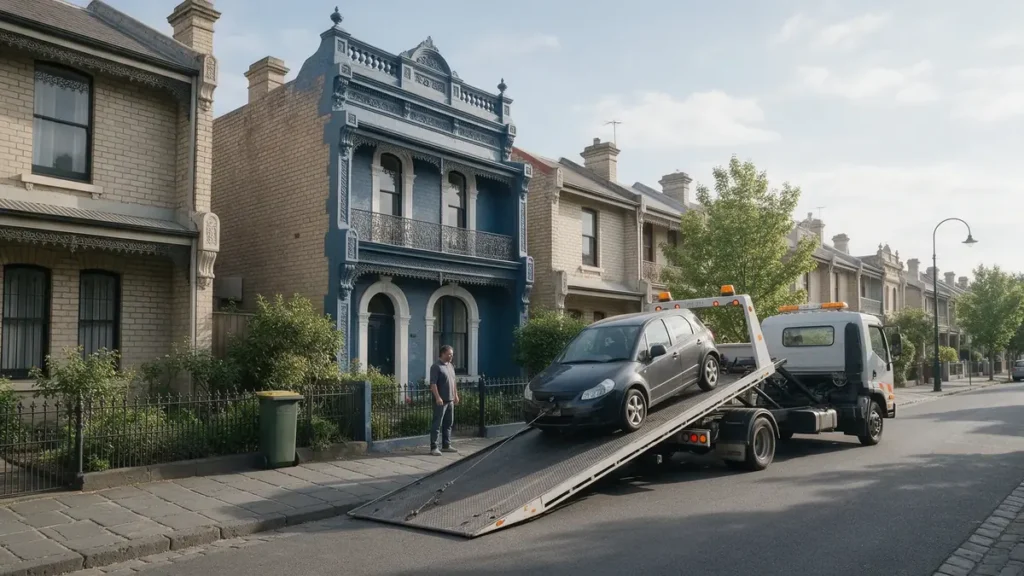
A car that rolls freely is quicker to load. One with seized wheels or no keys may need different equipment, which is why the buyer needs to know in advance. Our junk car towing and pickup page explains how collection works for cars that cannot be driven.
Step 5: Prepare the car for handover
Do a final sweep of the car a day or two before collection. Owners most often leave behind:
- Toll tags in the windscreen
- Garage door and gate remotes
- Sunglasses, documents and coins in the glovebox and console
- Child seats and items under the seats or in the spare wheel well
- Parking permits and fuel cards
Take a few photos of the car, the odometer and the VIN plate. They give you a record of the car’s condition at handover if a question comes up later.
You do not need to clean the car or fix anything. A wrecker values parts and metal, so cosmetic work does not change the price.
Step 6: Deal with the registration
This is the step most sellers get wrong. The VicRoads guide to disposing of a vehicle sets the order: first remove the number plates and cancel the registration, then sell the vehicle to an auto wrecker. The quickest way to cancel is through your myVicRoads account.
Cancelling also opens the door to a refund of unused registration. Under the VicRoads cancellation rules, the refund covers the time left, minus a $21.50 processing fee and 10% of the Transport Accident Commission (TAC) charge. To claim it, you upload one of the following:
- A photo of both number plates cut in half
- An insurance report or wrecker’s receipt, if the car is written off
- A statutory declaration, if you no longer have the plates
You do not need to return standard plates to VicRoads. Custom or personalised plates are different. If you want to keep them, you cannot cancel online, and you need to call VicRoads to transfer them or put them on retention.
Timing matters. Once the registration is cancelled, the car is unregistered and should not be driven on the road. Cancel close to collection day, after the tow is booked.
If the car is already unregistered, there is nothing to cancel, and the sale can go ahead with proof of ownership. Our guide to selling an unregistered car in Victoria covers that case.
If you do sell a registered car with its plates on, VicRoads requires a notice of disposal within 14 days. Without it, fines and tolls linked to the car can still reach you.
Step 7: Hand over the car and get paid
On collection day, the buyer checks that the car matches the description. Then the paperwork and payment happen, in that order of priority for you.
Show your photo ID. Victorian scrap metal laws require buyers to record the seller’s name, address and identification details, along with the vehicle’s VIN. A buyer who does not ask for ID is not following the rules.
Expect a bank transfer. Victoria banned cash for scrap metal in May 2018. Consumer Affairs Victoria’s scrap metal rules state that a vehicle sold as scrap, working or not, must be paid for by electronic funds transfer or a non-transferable cheque. So “cash for cars” means you are paid for the car, not handed notes.
Sign only after payment arrives. Consumer Affairs Victoria advises sellers not to sign any document that transfers ownership until payment has been received. Check that the transfer shows in your account, or that you hold the cheque, before you sign.
Get a receipt. It should show the date, the buyer’s business name, the VIN and the amount paid. Keep it. You may need it for a registration refund or to answer a fine notice later.
Then hand over the keys and let the driver load the car.
Step 8: Close everything off after the sale
A few accounts still carry the car’s details after it leaves. Close them within a day or two:
- Insurance. Cancel the policy and ask about a refund of unused premium.
- Toll account. Remove the vehicle and its plate number from your account so later trips are not charged to you.
- Registration refund. If you have not claimed it yet, lodge it through myVicRoads with your evidence.
- Records. Store the receipt, the quote, your photos and any VicRoads confirmation together.
Common mistakes when selling to a wrecker
| Mistake | What it causes | How to avoid it |
|---|---|---|
| Vague description when quoting | Price drops on collection day | List damage, missing parts and access issues upfront |
| Ignoring finance owing | Sale cannot proceed | Run a PPSR search before quoting |
| Leaving the registration active | Tolls and fines in your name | Cancel through myVicRoads, or lodge a notice of disposal if sold registered |
| Signing transfer papers first | No leverage if payment fails | Sign only after the money shows |
| Forgetting custom plates | Plates leave with the car | Arrange retention with VicRoads before collection |
| Leaving the toll tag in the car | Charges for someone else’s trips | Remove the tag and update your toll account |
Frequently asked questions
Do I need to be home when the wrecker collects the car?
Someone usually needs to be there to hand over the keys, show ID and confirm payment. If you cannot be present, discuss the arrangement with the buyer in advance. Do not hand over signed transfer papers before payment.
Do I need a roadworthy certificate to sell to a wrecker?
No. A roadworthy is needed when a registered vehicle is transferred to a new owner for road use. A car sold for wrecking is not going back on the road under your registration.
Can I sell a car that is not in my name?
Only with the owner’s written authority, or as the executor or administrator of a deceased estate with supporting documents. The buyer must record who sold the car, so ownership needs to be clear.
What happens to my car after the wrecker takes it?
Licensed recyclers drain fuel, oil and coolant, remove the battery and refrigerant, then strip saleable parts. The remaining shell goes for metal recycling. EPA Victoria’s guidance for auto recyclers sets out how these fluids and batteries should be handled to protect soil and waterways.
Ready to sell your car the straightforward way
Selling to a wrecker comes down to order and evidence. Clear any finance, describe the car honestly, cancel the registration at the right time, show your ID, and sign over the car only after the transfer lands. Keep your receipt, and close off insurance and tolls the same week.
When you are ready for the first step, request a quote for your car through our contact page, or see how our cash for cars service handles collection and paperwork for Melbourne owners.
Let’s Get It Sorted
Ready to Talk Through Your Project?
Share the details with our team and take the next step.
Call today:
0493 825 076