Selling a car for parts in Melbourne means one of two things. You either sell the whole vehicle to a wrecker who dismantles it and resells the usable components, or you remove and sell the parts yourself, then dispose of what is left. The first involves far less work for you. The second can return more money, but only for the right car and the right seller.
A car is worth more for parts than for scrap when it still has a sound engine, gearbox, panels or electronics that other owners need. If those parts are worn out, damaged or from a model nobody repairs anymore, the car is mostly metal. Knowing which group your car falls into is the first step to getting a fair outcome, and this guide shows you how to tell.
Selling for Parts vs Selling for Scrap: What Is the Difference?
The difference is what the buyer plans to do with the car, and that drives the price.
- Selling for parts: the buyer pulls reusable components, tests them and resells them. The car’s value depends on which parts are still good and how much demand there is for them.
- Selling for scrap: the buyer depollutes the car and sends the shell for metal recycling. The value depends mostly on weight and the scrap metal market.
In practice, most wreckers do both. A car arrives, the saleable parts come off, and the stripped body goes to scrap. That is why two cars of the same age can attract very different quotes. A common model with a healthy engine has parts value. A rare import with a seized motor and a rusted body is closer to scrap value.
The scale of this trade is large. Around 850,000 vehicles reach the end of their life in Australia each year, according to a study by the Federal Chamber of Automotive Industries and the Motor Trades Association of Australia. The same research found that the industry recovers about 70 per cent of the resulting waste. Parts reuse is a big part of that recovery, because a part sold again is a part that does not need to be made new.
What Parts Do Wreckers Salvage From a Car?
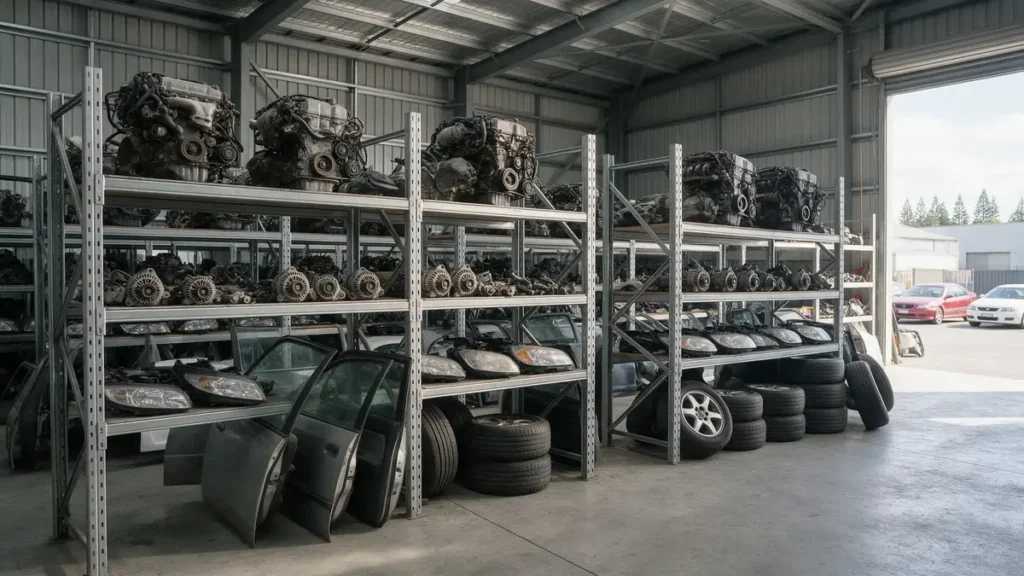
Wreckers salvage parts that are in demand, can be tested, and are safe to resell. The exact list depends on the model, but these components usually carry the most value:
- Engine and gearbox: the most valuable items in most cars, provided they run and are not seized or overheated.
- Catalytic converter: contains precious metals, so it has value even when the rest of the car does not.
- Body panels and doors: bonnets, guards, doors and boot lids for popular models, especially in common colours.
- Lights and glass: headlights, tail lights and mirrors are expensive new and easy to resell.
- Wheels and tyres: alloy wheels and tyres with good tread.
- Electronics and modules: starter motors, alternators, air-conditioning compressors, radiators, infotainment units and control modules.
- Interior parts: seats, trim panels, dashboards and switchgear in good condition.
Before any of that happens, the car must be made safe. EPA Victoria’s auto recyclers guideline sets out how recyclers should drain fuel, engine oil, coolant and other liquids, and remove batteries and refrigerant gas, before dismantling begins. The guideline warns that one litre of oil can contaminate up to one million litres of water, which is why fluids must never go down a stormwater drain.
What Makes a Car Worth More for Parts?
Five factors decide whether a wrecker values your car for parts or just for metal.
- Model popularity: parts from cars that are common on Melbourne roads sell quickly, so wreckers pay more for them.
- Mechanical condition: a running engine and a smooth gearbox lift the value more than any other factor.
- Damage location: a car hit in the rear may still have a perfect front end, engine and lights to salvage.
- Completeness: a car missing its engine, wheels or catalytic converter is worth much less than a complete one.
- Water and fire damage: flood and fire damage ruin wiring and electronics, so those parts usually cannot be resold.
If your car stopped running because of a major mechanical failure, the rest of it may still have value. Our guide to selling a car with a blown engine in Melbourne covers that situation in detail. For a broader look at how quotes are calculated, see how much wreckers pay for cars in Melbourne.
Should You Part Out a Car Yourself?
Parting out a car privately can earn more than selling it whole, but it costs time, space, tools and know-how. For most Melbourne owners, especially in apartments or homes without off-street parking, the numbers do not work.
When parting out privately can make sense
- You have a garage or a large private driveway where the car can sit off the road for weeks or months.
- You have the mechanical skills and tools to remove engines, gearboxes and electrical parts safely.
- The car is a popular or enthusiast model with parts that sell well online.
- You can collect and dispose of every fluid legally.
The hidden costs of parting out
- Time: removing parts, photographing them, answering enquiries and meeting buyers takes many weekends.
- Unsold parts: the high-value items sell first. Interior trim, small brackets and worn parts often never sell.
- Fluids and waste: you are responsible for disposing of oil, coolant, brake fluid, fuel and the battery properly. Under Victoria’s Environment Protection Act 2017, the general environmental duty applies to individuals as well as businesses.
- Registration: an unregistered car cannot legally be parked on a public road, so it must stay on private land while you work on it.
- The leftover shell: once the valuable parts are gone, you still need someone to collect and recycle the body.
Legal points private sellers often miss
Selling a few parts from your own car is not the same as running a business. In Victoria, anyone who carries on the business of buying and selling second-hand goods must register as a second-hand dealer. If you start buying cars to strip and resell, you may cross that line.
Buyers of your parts also have fewer protections than buyers from a business, and they will know it. Expect them to test, inspect and haggle. Be honest about the condition of every part, and keep a record of what you sold and to whom.
What Happens to a Stripped Car Shell?
A stripped shell is still a vehicle in the eyes of the law, and it has to be disposed of properly. Victorian law classes a written-off light vehicle with excessive stripping damage, meaning wheels, panels, doors or interior parts removed, as a statutory write-off. A statutory write-off can only be used for parts or recycling. It cannot be registered again.
Wreckers have their own obligations here. A motor wrecker that dismantles a vehicle must record it on the Written-Off Vehicles Register within seven days of starting, if it is not already recorded. That record stays with the Vehicle Identification Number (VIN), which stops a stripped car from being rebuilt and passed off as clean.
A shell with no engine, wheels or catalytic converter is worth far less than a complete car, and some collectors will charge to take it. If you plan to part out a car, get a quote for the whole car first. That number is your benchmark for whether parting out is worth the effort.
How to Sell a Car for Parts to a Wrecker, Step by Step
Selling the whole car to a wrecker takes most of the work off your hands. Follow these steps to keep it clean and legal.
- Gather the car’s details. Note the make, model, year, kilometres, whether it starts and drives, and any damage. Photos help a buyer quote accurately.
- Check for finance. A Personal Property Securities Register (PPSR) search costs $2.00 online and shows whether a security interest, such as a car loan, is recorded against the VIN. Any loan must be paid out before you sell.
- Get a quote. Describe the car honestly, including missing parts. A quote based on wrong details is likely to change when the car is inspected.
- Remove what you want to keep. Take out personal items, toll tags, child seats, and any aftermarket parts you plan to reuse. Tell the buyer if you remove anything that was included in the quote.
- Prepare your documents. Bring photo ID and proof of ownership such as the registration certificate. Our checklist of documents needed to sell a car to a wrecker in Victoria lists every item.
- Get paid by bank transfer. See the payment rules below.
- Finish the paperwork. If the car is registered, lodge a notice of disposal with VicRoads within 14 days, or cancel the registration and hand in the plates.
How Wreckers Pay in Victoria
Victorian law does not allow wreckers buying cars for scrap to pay in cash. Since 30 May 2018, the scrap metal laws enforced by Consumer Affairs Victoria have banned anyone dealing in scrap metal from paying or receiving cash. Payment must be by electronic funds transfer or a cheque that is not transferable or payable to cash.
The buyer must also record the vehicle identifier, your name and address, and your identification details. That is why you will be asked for photo ID. Treat any offer of cash in hand as a warning sign rather than a perk.
Finishing the Sale With VicRoads
The car must leave your name properly, or you can be held responsible for what happens to it next. When you sell a registered vehicle, VicRoads requires a notice of disposal within 14 days, which you can lodge through your myVicRoads account. If you skip it, fines and tolls linked to the car can still reach you.
If you cancelled the registration before the sale, return or hand over the number plates as VicRoads requires. You may be eligible for a refund on the unused part of your registration. Keep the payment record, the buyer’s details and any transfer paperwork.
Common Questions About Selling a Car for Parts
Is my car worth more for parts or scrap?
It is worth more for parts if it has a working engine or gearbox, undamaged panels or lights, and comes from a popular model. If those parts are worn, damaged or hard to resell, the value sits closer to scrap metal.
Can I sell a car for parts without a roadworthy?
Yes. A roadworthy certificate is not needed if the registration is cancelled before the sale or the buyer is a licensed motor car trader. Cars sold for parts are not going back on the road in their current form.
Do I need to keep the catalytic converter on the car?
Yes, if you want the best quote for the whole car. Wreckers value it highly, and removing it lowers the offer for the rest of the vehicle.
Can I sell a car for parts if it is unregistered?
Yes. You still need proof of ownership and photo ID, and the car must be collected from private property because unregistered cars cannot legally be parked on public roads.
Choosing the Route That Fits Your Car
Parting out a car yourself pays only when you have the space, tools, time and a model that people actively want parts for. For everyone else, selling the whole car to a wrecker turns the same parts value into one transaction, with the fluids, shell and register obligations handled by a business set up for it. Start with a quote for the complete car, check the PPSR, expect payment by bank transfer, and lodge the notice of disposal once it is gone.
To see how we assess vehicles for reusable components, read about our used car parts salvage service, or request a quote for selling your car for parts with its make, model and condition.
Let’s Get It Sorted
Ready to Talk Through Your Project?
Share the details with our team and take the next step.
Call today:
0493 825 076